The Tokyo Connection

How Hawaii’s largest condo management company passed from local hands to a foreign conglomerate — and what’s happening inside it now.
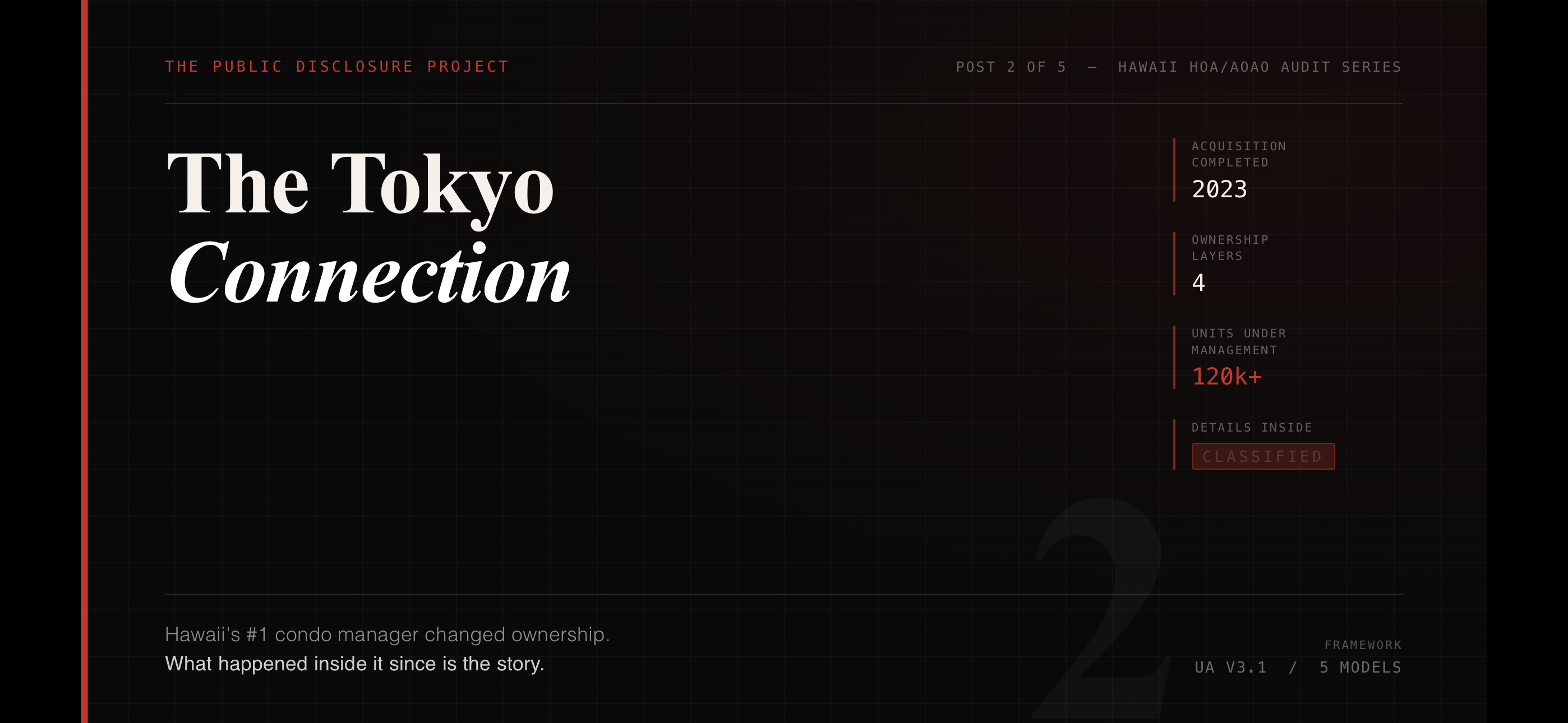
In March 2020, a Tokyo-listed building management conglomerate quietly acquired a 50% stake in the holding company that owns Hawaii’s largest AOAO management firm. No press conference. No local news coverage. A corporate disclosure filed in Japan. By August 2023, the acquisition was complete. Hawaiiana Management Company — the firm managing 750+ properties and 120,000+ units across six Hawaiian islands, the company that runs board meetings, collects fees, manages vendors, and produces financial reports for hundreds of thousands of Hawaii condo owners — is now wholly owned by Nippon Kanzai Holdings Co., Ltd., traded on the Tokyo Stock Exchange under ticker 9347. This post maps exactly how that happened, what’s been built since, and why the operational details matter more than the ownership headline.
Who Is Nippon Kanzai?
Nippon Kanzai Holdings is not a small foreign investor taking a passive stake in a Hawaii business. It is a large, publicly traded Japanese building management conglomerate with consolidated annual revenue that grew from approximately ¥104 billion in 2021 to ¥139 billion in 2025 — roughly $880 million USD at current exchange rates.
Its core business in Japan is building management: maintaining, operating, and managing large residential and commercial properties. The Hawaiiana acquisition was explicitly framed in its investor materials as overseas expansion — bringing its established management model into the U.S. market through a dominant local platform.
That context matters. This is not a passive capital investment. This is a strategic operational expansion by a company that knows exactly what it is doing in the property management space.
The Acquisition Timeline
The ownership transfer did not happen overnight. It followed a deliberate, staged entry:
March/April 2020 — Capital Alliance Entry
Nippon Kanzai Co., Ltd. acquires 50% of Hawaiiana Holdings Incorporated from Swell International Inc., a locally operated Hawaii real estate company. The disclosure describes it as establishing a “capital alliance.” Hawaiiana Holdings is the non-public holding company that owns the operating entity — Hawaiiana Management Company, Ltd.
Note the structure: the acquisition target is a holding company, not the operating firm directly. Hawaiiana Management Company continues to operate under its established local brand. The ownership change is one layer up, invisible to the associations being managed.
April 2022 — Commercial Layer
Added Nippon Kanzai USA, Inc. — NK’s U.S.-domiciled subsidiary — acquires 90% of Pacific Property Group Inc. (PPG), a commercial property management company based in Honolulu, founded in 2007. PPG manages approximately 20 commercial buildings across Oahu.
NK now controls both the dominant residential AOAO manager and a commercial property manager in the same market simultaneously. Two separate segments of Hawaii’s property management industry under unified foreign ownership.
August 2023 — Full Control
Nippon Kanzai Holdings achieves full ownership of Hawaiiana Holdings Incorporated. The capital alliance becomes outright ownership. There are no longer minority partners, no local equity holders, no shared governance with Hawaii-based principals.
Hawaii’s #1 AOAO management company is now a wholly owned foreign subsidiary.
What’s Happening Inside Now
Ownership transfer is one thing. Operational integration is another. The details of what NK is doing inside Hawaiiana since acquisition are where the structural significance becomes concrete.
The Executive Secondment
In 2025, a Nippon Kanzai Holdings executive was seconded directly into Hawaiiana’s leadership team. His biography on Hawaiiana’s own website notes more than 25 years of experience in Japan’s real estate industry spanning structural engineering, construction management, commercial brokerage, asset management, fund management, and residential property management — and explicitly states he was seconded from Nippon Kanzai Holdings prior to 2025.A secondment is not a hire. It is a deployment. The executive remains an NK employee, reports within NK’s organizational structure, and returns to the parent company when the secondment ends. His presence inside Hawaiiana’s leadership is NK’s eyes, ears, and operational direction inside the firm it now owns.
The Accounting System Rollout
NK’s own financial materials — specifically its Q2 FY2025 investor document — contain this passage about Hawaiiana:
“The accounting system introduced to Keystone Pacific Property Management, LLC is planned to be introduced [to Hawaiiana] as part of the know-how-roll-out initiatives. Streamlining of the operations is aimed for.”
Keystone Pacific Property Management LLC is NK’s California-based subsidiary — a gated community and HOA management firm operating across Southern California. NK acquired a minority stake in Keystone Pacific in January 2017 and subsequently increased its position.
The accounting system being exported from Keystone Pacific to Hawaiiana is the operational template NK developed on the mainland being transplanted into the Hawaii market. “Streamlining of operations” is standard corporate language for margin expansion and vendor consolidation — replacing local systems, local vendors, and local processes with standardized ones that flow upward through the parent company’s reporting structure.
The Contract Structure
NK’s investor materials describe the property management contract model as running approximately 7 to 30 years in duration. Long-term contracts in a market where NK controls the dominant firm means competitive displacement of Hawaiiana by any alternative is structurally constrained. An AOAO board that wanted to switch managers would need to wait out its contract, find an alternative in a market NK dominates, and overcome the switching costs of transitioning 120,000+ units worth of financial records, vendor relationships, and institutional knowledge.
The long-term contract is the lock. The market position is the key that keeps it turned.
The Holding Structure
One of the consistent findings across the five-model audit was the opacity of the intermediary layer between NK and Hawaiiana’s day-to-day operations.
The structure runs:
Nippon Kanzai Holdings Co., Ltd. (Tokyo Stock Exchange: 9347, publicly listed Japan) ↓
Nippon Kanzai USA, Inc. (U.S.-domiciled subsidiary, non-public, ownership structure not disclosed) ↓
Hawaiiana Holdings Incorporated (Hawaii holding company, non-public) ↓
Hawaiiana Management Company, Ltd. (Operating entity, local brand, 750+ associations)
The operating entity that Hawaii condo owners interact with — Hawaiiana Management Company — sits three layers below the publicly listed parent. The financial flows, margin expectations, and operational directives that travel down that chain are not publicly disclosed. The associations paying management fees to Hawaiiana have no visibility into what portion of those fees ultimately leaves Hawaii entirely.
Swell International Inc. — the entity that sold the initial 50% stake to NK in 2020 — operated as a multilingual real estate brokerage with Japanese, Chinese, and Korean language capacity managing 230+ residential units in Honolulu. The prior owner of Hawaii’s largest AOAO manager was itself a firm with deep Japan real estate connections. The entry point for NK was not a cold acquisition. It was a warm handoff through an existing Japan-Hawaii real estate network.
The Second Firm
Hawaiiana is not the only AOAO management company in this audit’s scope.
Associa Hawaii — Hawaii’s second-largest AOAO manager with 400+ associations — is the Hawaii arm of Associa Inc., a Dallas, Texas-based national platform described as the largest outsourced manager of community associations in the United States. In June 2008, Associa received a minority investment from Summit Partners, a Boston-based private equity and venture capital firm. Summit Partners board members joined the Associa board upon investment.
The PE backing pre-dates the 2020 anchor date but is structurally operative throughout the audit window. National purchasing programs embedded in Associa’s operating model suggest vendor relationship standardization across managed communities — a mechanism for margin capture that operates below the visibility of individual association boards.
Together, Hawaiiana (NK-controlled) and Associa Hawaii (PE-backed national platform) manage the dominant majority of Hawaii’s 1,150+ AOAO-managed communities. One under a Tokyo conglomerate.
One under a Dallas private equity platform. Both operating in a market with no state regulatory oversight of management practices, no mandatory competitive bidding requirements, and no public disclosure of fee margins or vendor relationships.
What the Board Doesn’t Know
Every AOAO in Hawaii is governed by a volunteer board of unit owners. These boards hireand oversee the management company. In theory, they are the accountability mechanism.
In practice, the board of a mid-sized Honolulu condo association is a small group of volunteer residents with no property management expertise, no dedicated legal resources, no independent audit capacity, and no bargaining power against a firm that holds contracts across 750+ associations and is operationally backed by a billion-dollar Tokyo conglomerate.
The information asymmetry is total. The management company controls the financial records, the vendor relationships, the insurance placement process, and the institutional knowledge of the building. The board reviews summaries of what the management company chooses to present.
This is not a criticism of individual board members. It is a structural observation about what happens when a volunteer governance layer is placed between a captive fee-paying population and an institutionally owned management firm with no regulatory oversight above it.
The Sponge Test Result
The Universal Auditor v3.1 framework includes what it calls the Sponge Test — a direct comparison of each entity’s position at the baseline date versus the outcome date. For Nippon Kanzai Holdings, the result is unambiguous:
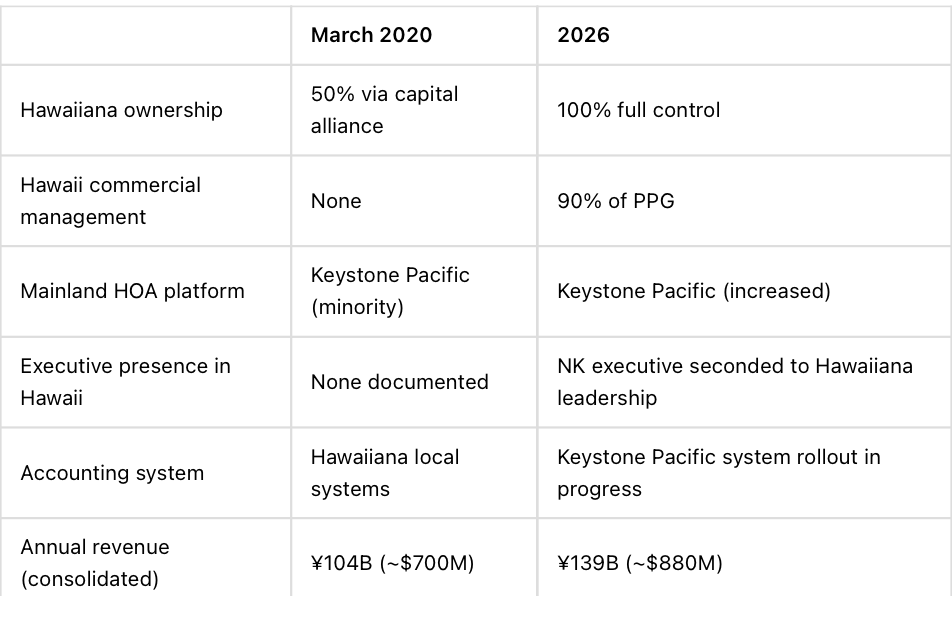
From minority partner to full operational control of Hawaii’s #1 residential AOAO manager, plus commercial property management, plus a mainland HOA platform, plus embedded executive presence, plus accounting system integration — all within six years, all through a non-public holding structure, all in a market where the regulatory infrastructure that could have provided visibility was blocked from forming.
What This Means for the Fee
The management fee is one line item inside your monthly AOAO fee. It is not the largest — insurance has become the fastest-growing component, and Post 3 maps that layer in detail. But it is the most structurally significant because the management company controls how all the other line items are calculated, vendor contracts are awarded, and financial reporting is produced.
When the management company is locally owned and competing for contracts in an open market, there is at least theoretical competitive pressure on the fee. When the management company is a wholly owned subsidiary of a Tokyo-listed conglomerate with 7-30 year contracts and no meaningful competition in its market segment, the theoretical competitive pressure disappears.
The fee is whatever the structure allows it to be.
And the structure, as of 2026, allows quite a lot.
Coming in Post 3
The insurance layer is where the audit produced its most underreported finding.
Hawaii’s dominant AOAO insurance specialist was quietly acquired by the world’s largest insurance broker in December 2025 — during the same period that individual AOAO insurance premiums were spiking 40% to 900%+ and Hawaii’s aggregate property insurance costs posted their largest annual increase in over a decade.
HRS 514B mandates the coverage. The statute ensures there is no exit. And the entity placing that mandatory coverage just moved inside a $24 billion global insurance conglomerate.
Post 3 maps the chain.
The Public Disclosure Project publishes structural accountability research on Hawaii’s housing, regulatory, and institutional systems. Subscribe to follow the series. Post 1: [Who Owns the Fee That Owns Your Home?]
Sources referenced in this post:
Nippon Kanzai Holdings Q2 FY2025 Financial Results (IR disclosure)
Nippon Kanzai Holdings IR notice, April 1, 2020 (Hawaiiana Holdings acquisition)
Nippon Kanzai Holdings IR notice, April 1, 2022 (Pacific Property Group acquisition)
Nippon Kanzai Holdings IR notice, January 6, 2017 (Keystone Pacific acquisition)
Nippon Kanzai Holdings Overseas Business page (operational details)
Hawaiiana Management Company website, Our Team page (executive secondment)
GlobalNewswire, June 2008 (Associa / Summit Partners investment)
Hawaii DCCA condominium division public records
HRS Chapter 514B (Hawaii Condominium Property Ac