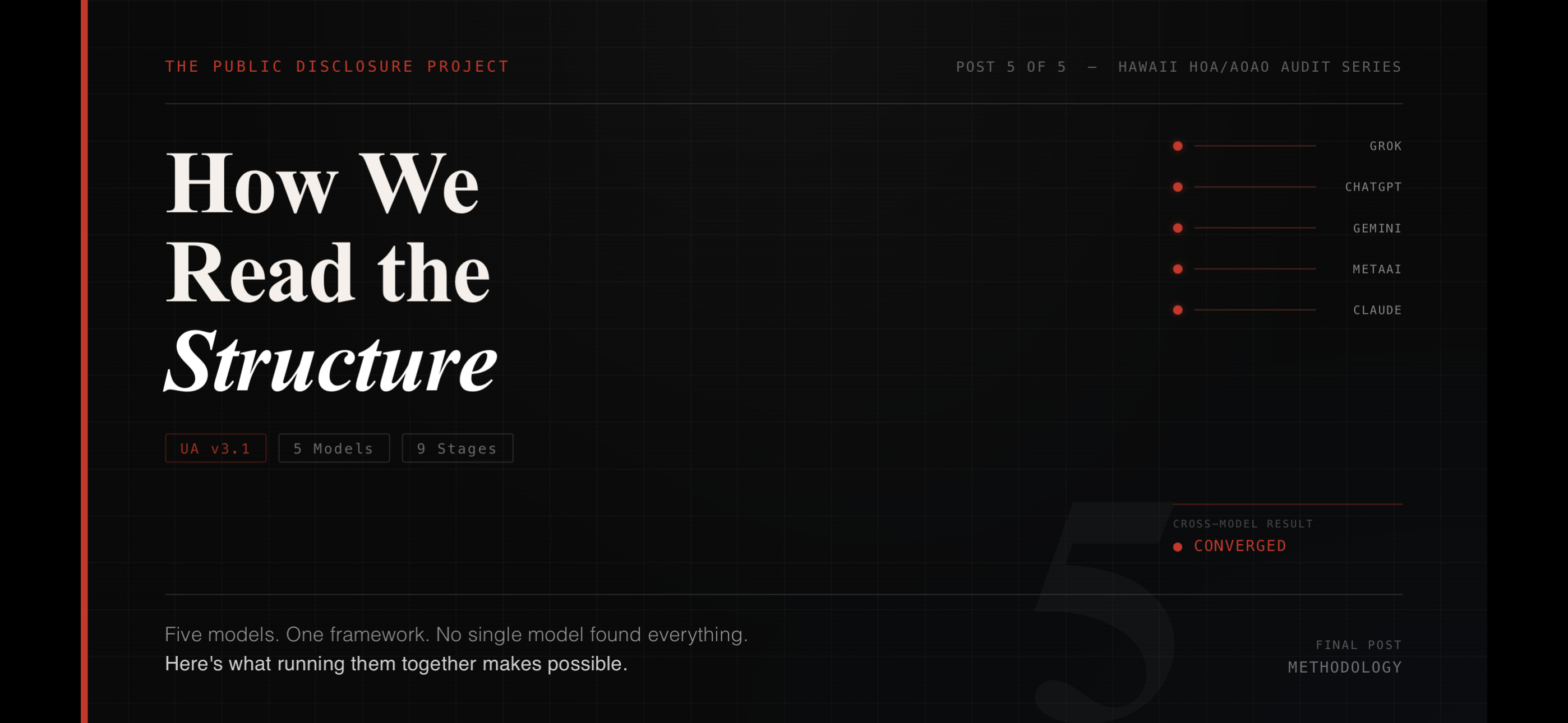
How We Read the Structure
The Universal Auditor v3.1 framework, the multi-model approach, and what this methodology makes possible that traditional investigation doesn’t.

The first four posts in this series documented findings. This post documents how those findings were produced.
That matters for two reasons.
First, the methodology is the credibility layer. Anyone can make claims about institutional consolidation. The question is whether the claims are grounded in a reproducible, evidence-gated process that can be stress-tested, challenged, and replicated. The Universal Auditor v3.1 framework was designed specifically to answer that question.
Second, the methodology is transferable. The audit that produced this series was run on Hawaii’s HOA/AOAO system. The same framework has been run on Hawaii’s homeless services contracting, automated traffic camera procurement, and legislative campaign finance. It can be run on any institutional system in any jurisdiction by anyone willing to apply it. That is the point.
This post explains how it works and what running it across five AI models simultaneously adds to the process.
The Problem This Framework Was Built to Solve
Standard investigative journalism follows the story. A reporter finds a tip, follows a thread, interviews sources, and publishes what they find. This works well for discrete events — a specific corrupt official, a single fraudulent contract, a documented lie.
It works less well for structural capture — the kind of institutional consolidation this series documented. Structural capture has no single event, no smoking gun, no villain delivering a confession. It is a pattern that emerges across many transactions, many entities, and many years. It is often entirely legal. The individual pieces look unremarkable in isolation. The pattern only becomes visible when you hold all of them in the same frame simultaneously.
The Universal Auditor v3.1 framework was built to hold that frame.
-----
How the Framework Works
The audit runs through nine sequential stages. Each stage has a specific function and specific output requirements. The stages cannot be skipped or reordered.
Stage 0: Retrieval
Gather key verifiable public sources from around the anchor date and the outcome year. The anchor date for this audit was March 2020. The outcome year was 2026. Everything retrieved must be a real, citable document — a corporate disclosure, a legislative record, a financial filing, a verified news report.
Stage 1: Bucket Identification
Classify each entity in the target set by type. Type A entities are regulatory — government agencies, statutory frameworks, legislative bodies. Type B entities are execution — the firms that actually do the work, collect the fees, place the insurance, manage the properties. Type C entities are investment — the capital behind the execution layer. Type D entities are narrative — media, advocacy organizations, think tanks that shape the public understanding of the system.
Stage 2: A-B-C-D Mapping
Identify entities that appear in more than one type category simultaneously. A firm that is both an execution node and a capital investment vehicle is more structurally significant than one that occupies only a single category. Multi-type nodes are where the density concentrates.
Stage 3: Density Assessment
Count the intersection types at each entity. Rank the high-density nodes. These become the primary subjects of the remaining analysis.
Stage 4: The Sponge Test
Compare each entity’s position at the anchor date to its position at the outcome year. What did it control in March 2020? What does it control in 2026? What is the delta? Which entities absorbed the most value, control, or market position across the audit window?
Stage 5: Verification
Every claim from Stage 4 must be supported by a direct citation. No inference without a source. This is where the framework enforces its evidentiary discipline.
Stage 6: Visual Mapping
Map the ownership and flow relationships as a directed graph. Who owns what. Who controls what. Where the money flows. The visual makes the pattern legible in a way that prose cannot.
Stage 7.5: Evidence-Only Gate
A hard gate before the entropy detection stage. Before proceeding, every intersection identified in the density assessment must be supported by a direct citation from Stage 0. Claims without citations are removed. This is the framework’s primary anti-hallucination mechanism.
Stage 7: Entropy Detection
Identify the dark nodes — the non-public holding companies, the LLCs, the private intermediaries, the undisclosed ownership structures that sit between the public-facing entities and the capital behind them. In this audit: Hawaiiana Holdings Incorporated, Nippon Kanzai USA Inc., Keystone Pacific Property Management LLC, Tradewind Group.
Stage 8: Logistics Correlation
Pair structural events with cost signals using direct citations from both facts. The acquisition of Atlas by Marsh McLennan Agency paired with the 13% statewide insurance premium surge. The NK executive secondment paired with the Keystone Pacific accounting system rollout. The pairs must be sourced independently — you cannot cite the same document for both the structural event and the cost signal.
Stage 9: Red-Flag Checklist
Four criteria determine the overall pattern strength:
1. Multiple intersection types at the same node
1. Dark node presence
1. Logistics/cost alignment pairs
1. Asset or cost offload signals
Meeting all four criteria produces a HIGH pattern strength designation. This audit met all four across three of five models.
Why Five Models
The same audit was run across five large language models simultaneously: Grok, ChatGPT, Gemini, MetaAI, and Claude. Each model ran the full nine-stage protocol independently, without access to the other models’ outputs during its run.
This is not about using AI to do the research. It is about using model divergence as a signal detection mechanism.
Here is the logic: if five independent systems, each with different training data, different retrieval tendencies, and different inference thresholds, all independently arrive at the same structural finding — that finding is more robust than if one system found it alone. Convergence across independent runs is evidence of structural reality, not artifact of a single model’s biases.
Divergence is equally informative. When one model finds something the other four miss, that finding requires verification before it can be treated as high-confidence — but it also signals a potential blind spot in standard analytical approaches. In this audit, the Atlas/Marsh McLennan insurance acquisition was found by only one model in the initial run. Independent verification via the December 2025 MMA press release confirmed it. One model’s unique finding became the most underreported structural development in the entire audit.
The multi-model approach also produces a calibration record. Each model has a systematic bias:
Grok is tuned toward evidentiary conservatism. It refuses to connect structural dots without explicit proof. This makes it an excellent falsification tool — if Grok finds a pattern, it is highly evidence-grounded. Its Low pattern strength designation on this audit is not a finding against the pattern; it is a floor that the other models exceeded with additional evidence.
ChatGPT functions as a balanced systems interpreter. It correctly identified the AOAO nonprofit governance layer as an opacity mechanism — individual association boards as weak counterparties with no leverage against institutionally owned management firms. This was a genuine structural contribution the other models underweighted.
Gemini operates as a macro and outcome integrator. It was the first to pull the UHERO 2026 Housing Factbook fee data and connect the $882 Honolulu median to the structural upstream. It also surfaced the Kamehameha Schools to Daisho $510 million land sale — a capital repositioning event at the ground rent layer that the other models treated as background. Gemini’s outputs are live-web dependent and require cross-verification, but its retrieval range is wider than the other models on current-year data.
MetaAI has underappreciated legislative retrieval depth. It was the only model to surface HB302 — the 2020 oversight study directive — which became the anchor for Post 4’s entire legislative timeline. Three other models missed it entirely. MetaAI also flagged the Liliuokalani Trust hotel sales as active capital repositioning rather than static land-holding. Its pattern strength scoring of HIGH with all four criteria was consistent with Gemini and Claude.
Claude produced the deepest structural synthesis. It found the Atlas/Marsh McLennan acquisition chain, articulated the HRS 514B statutory lock mechanism, documented the NK executive secondment and the Keystone Pacific accounting rollout as operational integration signals, and produced the fullest Stage 7 entropy detection output. It also articulated the price floor transmission mechanism — how the mandatory fee stack injects a structural floor into the entire Hawaii housing market, not just the condo segment.
No single model found everything. Together they found more than any one of them could have found alone. The methodology is designed to exploit that.
What Cross-Model Convergence Means
When three or more models independently arrive at the same structural finding, that convergence functions as a validity signal analogous to independent source corroboration in traditional journalism.
A single source saying something is a lead. Two independent sources saying the same thing is a story. Three independent sources saying the same thing is a confirmed fact.
Cross-model convergence works the same way. The Nippon Kanzai acquisition chain was confirmed by all five models. That is the highest-confidence finding in this audit. The Atlas/MMA acquisition was confirmed by one model and independently verified by primary source. That is a high-confidence finding that required additional verification steps. The leasehold ground rent delta — whether trust ground rents increased between 2020 and 2026 — was not confirmed by any model because the primary source data to confirm it has not been pulled. That remains an identified gap.
The methodology distinguishes between these confidence levels explicitly. It does not treat a five-model convergence the same as a single-model finding. The calibration is built into the framework.
What This Makes Possible
Traditional investigative journalism requires either institutional resources — a newsroom, editors, legal support, time — or extraordinary individual commitment. Both are scarce. The result is that most structural capture goes undocumented not because it is hidden, but because the analytical labor required to surface it exceeds what individuals or small outlets can sustain.
The Universal Auditor v3.1 framework with multi-model triangulation changes that ratio.
The corporate disclosures, legislative records, financial filings, and news reports that produced this series were all publicly available. None required a source with insider access. None required a FOIA request. All of them required someone to look at them in the right sequence, with the right framework, and hold the pieces in the same frame long enough to see the pattern.
AI models can do much of that retrieval and classification work at a speed and scale that an individual researcher cannot match. The human layer in this methodology is not the retrieval — it is the framework design, the evidence gate, the cross-model calibration, and the final synthesis judgment. Those cannot be automated. The retrieval can.
This means that structural accountability research; the kind of analysis that maps institutional capture, regulatory failure, and capital consolidation; is no longer exclusively the domain of well-resourced institutions. A single person with a structured framework and access to five AI models can produce the kind of multi-source, evidence-grounded structural analysis that previously required a team.
That is what this series demonstrated. Whether it demonstrated it convincingly is for the reader to judge.
The Mandatory Closing
Every output of the Universal Auditor v3.1 framework ends with the same statement. It belongs here too.
This series describes observed structural alignments, market consolidation patterns, ownership concentration, incentive structures, and legislative outcomes only. It is not evidence of intent, conspiracy, or legal violation by any named entity or individual. The entities documented in this series — Nippon Kanzai Holdings, Marsh McLennan Agency, Associa Inc., Kamehameha Schools, the Community Associations Institute — are operating legally within the systems they occupy.
What the audit documents is the system, not the intent. Systems can produce harmful outcomes without anyone in them intending harm. The mandatory fee stack that extracts from Hawaii condo owners, the oversight gap that allowed it to consolidate, the legislative record that shows it was preventable — none of that requires a conspiracy. It requires incentives, legal structures, and the absence of regulatory friction.
Understanding the system is the precondition for changing it. That is what this series was for.
The Full Audit Report
The complete Universal Auditor v3.1 output — all nine stages, all five model runs, the cross-model synthesis, the dark node register, and the full legislative timeline — is available as a standalone document linked here.
That document is the source material for this series. The posts are the readable layer. The report is the evidentiary foundation.
If you are a journalist, researcher, legislator, or Hawaii resident who wants to build on this work — the framework, the methodology, and the source citations are all available. The goal was never to own the finding. The goal was to make it visible.
The Public Disclosure Project publishes structural accountability research on Hawaii’s housing, regulatory, and institutional systems.
Post 1: Who Owns the Fee That Owns Your Home?
Post 2: The Tokyo Connection
Post 3: The Mandated Market
Post 4: The Preventable Gap
Framework reference:
Universal Auditor v3.1 — developed and iterated across multiple Hawaii institutional audits, late 2025-ongoing
Multi-model triangulation protocol: Grok, ChatGPT, Gemini, MetaAI, Claude — parallel independent runs, May 8, 2026
Full audit report: Hawaii HOA AOAO audit